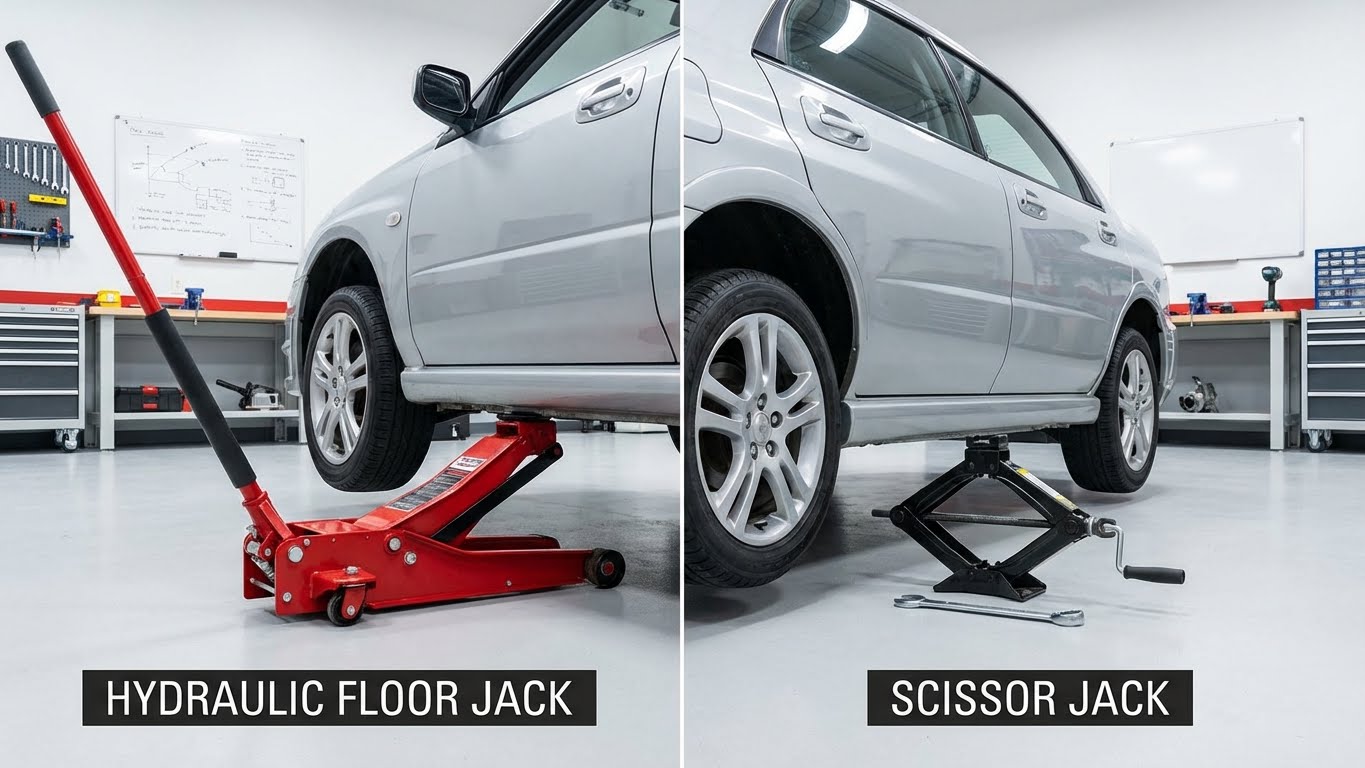
You need the right jack for safe, fast car lifting. A floor jack uses hydraulic power and lifts faster and higher for heavier or frequent work, while a scissor jack uses a screw and stays compact and cheap for emergency tire changes.
If you work on cars often or need to get under the vehicle, a floor jack saves time and effort. If you want something small to keep in the trunk for a flat, a scissor jack fits easily and costs less.
Key Takeaways
- Choose a floor jack for heavier lifts and frequent use.
- Choose a scissor jack for emergency, compact, low-cost needs.
- Practice safe lifting and use jack stands for any under-car work.
What Is a Floor Jack?

A floor jack is a low-profile, hydraulic tool that lifts a vehicle by pressing a piston with fluid. You get smooth, fast lifting and precise height control for tire changes, brake work, or accessing the underside.
Design and Mechanics
A floor jack uses a hydraulic cylinder, pump handle, and a saddle that contacts your vehicle’s lift point. When you pump the handle, fluid moves into the cylinder and raises the saddle. Releasing the valve lets fluid flow back and lowers the jack slowly and controllably.
Most floor jacks have wheels and a wide base so you can roll them under low cars and stabilize heavy loads. Common load ratings run from 2 to 3 tons for consumer models. Look for a bypass valve and safety overload feature to prevent over-pumping.
Common Uses
You will use a floor jack for routine maintenance like wheel removal, brake jobs, and light undercarriage access. Shops rely on floor jacks to lift cars quickly to place jack stands or to position vehicles on ramps.
Floor jacks work well for lower-riding sedans and light SUVs because their low profile lets you reach factory lift points. For frequent or heavier lifting, professionals often pair a floor jack with jack stands and a service ramp for safe, longer-duration support. See NHTSA guidance for vehicle safety when lifting.
Advantages of Floor Jacks
Floor jacks lift faster and with less effort than scissor jacks because hydraulics do the work. You can lift to a greater height with smoother control, making tasks under the vehicle easier and safer.
They adapt to most factory lift points with a pivoting saddle and a wide contact pad. Durable steel construction and higher load ratings give a longer service life. For reliable instructions and best practices, consult your vehicle’s owner manual and a trusted source like SAE International for workshop standards.
What Is a Scissor Jack?
A scissor jack is a compact mechanical device that lifts part of a vehicle using a screw and linked metal arms. It fits in trunks and emergency kits and works without hydraulics, so you can operate it by hand.
Design and Mechanics
A scissor jack uses two crossed metal arms that form an “X.”
Turning the center screw draws the arms together or pushes them apart. This motion raises or lowers the jack. The load sits on a small saddle at the top of the arms.
Most scissor jacks are made of stamped steel and weigh 5–15 pounds. They usually have a threaded rod with a hex or square end you turn with a wrench or crank. Maximum lift height is limited, often 4–12 inches, so they suit trunk-to-rail lifts rather than full access under the car. For safety, the jack relies on mechanical friction and the screw thread; it will hold position when properly engaged, but you should always use jack stands before working under the vehicle. For official specifications and safe operation, check your vehicle manual or a trusted source like the NHTSA.
Typical Applications
You’ll most often see a scissor jack used for tire changes on sedans, hatchbacks, and compact SUVs. It fits small curb-side jobs because it’s light and stores easily in a trunk compartment.
Emergency roadside use is the main role. You won’t get much clearance for brake or suspension work. Dealers and many carmakers include scissor jacks with new cars, so you can change a flat without calling a tow. Use jack stands or wheel chocks when you need to stay under the vehicle briefly.
Advantages of Scissor Jacks
Scissor jacks are cheap, simple, and highly portable. You can carry one with minimal space impact, and it requires no hydraulic fluid or pumping.
They are easy to use for quick lifts and tire swaps; the hand crank gives you precise control over the lift. Their low weight makes them safer to handle than heavy floor jacks in some roadside situations. For more details on selection and safety, see manufacturer guidance from organizations like SAE International or carmakers’ owner guides.
Key Differences Between Floor Jack and Scissor Jack
Floor jacks use hydraulic power and roll on a low-profile frame. Scissor jacks use a screw mechanism and are compact for storage. The next parts compare their capacity, how easy they are to use, and how fast they lift.
Lifting Capacity
Floor jacks typically lift between 2 and 3 tons for consumer models, with heavy-duty shop models rated 3–6 tons or more. That higher capacity makes floor jacks a better choice if you work on trucks, SUVs, or regularly lift at the vehicle’s control arms or subframe.
Scissor jacks usually rate around 1–1.5 tons, which covers most passenger cars for emergency tire changes. They sit under the pinch weld or lift point and rely on a threaded screw, so they don’t handle high loads or side loading as well as floor jacks.
If you need to lift heavier vehicles or perform repairs under the car, choose a floor jack. For occasional roadside use and minimal storage space, a scissor jack can suffice.
Ease of Use
A floor jack uses a pump handle you push to raise the vehicle. It rolls on casters and positions quickly under the jacking point. You’ll find it easier to align and operate, and it offers smoother control when raising and lowering.
A scissor jack requires turning a crank or wrench to open the screw. It takes more effort and time, and the narrow base means it can feel less stable on soft or uneven ground. You may also need to position wheel chocks and use more care to avoid slipping.
If you want less physical effort and faster positioning, a floor jack makes work simpler. If you only need a light, compact option for emergencies, a scissor jack remains usable but more work.
Speed and Efficiency
Floor jacks lift much faster because a few pumps move the carriage several inches. That saves time when you change tires or work under the car frequently. A hydraulic floor jack also lowers smoothly with a control valve, letting you fine-tune height quickly.
Scissor jacks move slowly since each turn of the screw raises the vehicle a small amount. That makes them inefficient for repeated use or for raising a car high enough for extensive repairs. They also require more physical effort per inch lifted.
For routine maintenance or any job that needs frequent lifting, a floor jack increases efficiency. For rare, emergency use where storage space and weight matter, a scissor jack is adequate but slower.
Safety Considerations
You must focus on stable lift points, correct load placement, and knowing how each jack can fail. Follow manufacturer limits, use jack stands, and inspect gear before every lift.
Stability During Lifting
Stability comes from the jack base, the contact point, and the surface under the jack. For a floor jack, position it on a flat, hard surface and center the saddle on the vehicle lift point. The wide base and low profile give better lateral support, but you still need the jack wheels locked or chocked wheels to stop movement.
Scissor jacks sit narrow and tall when raised, which makes side-to-side tipping easier. Use them only at the vehicle’s designated pinch-weld or scissor-recommended point and avoid raising the car higher than needed. If ground is soft, put a plywood slab under the jack to spread the load.
Always block the wheels opposite the lifted corner. Never get under the vehicle supported only by a jack. Lower the vehicle slowly and check for any wobble before placing jack stands.
Load Placement
Place the jack directly under the vehicle manufacturer’s lift points. These points handle concentrated load and keep the chassis from bending.
On a floor jack, center the saddle and avoid off-center lifts that can shift the car. If you lift a corner and the saddle contacts a control arm or pinch weld, reposition until the contact is square. Use the jack’s load rating and never exceed it.
With a scissor jack, the smaller contact pad needs precise alignment. Tighten the crank slowly and stop if contact slips. Use jack stands at the same lift points after raising the car, and transfer the load from the jack to the stands before doing work.
Risk of Mechanical Failure
Inspect jacks for rust, bent components, leaks, and worn threads before each use. Hydraulic floor jacks can fail from seal leaks or fluid loss; check fluid level and test lift under no-load first. Listen for unusual hissing or sinking that indicates a leak.
Scissor jacks rely on threaded spindles that can strip or bend. If the crank turns without lifting or feels loose, stop and replace the jack. Avoid using makeshift handles or extensions that increase torque and risk stripping parts.
Keep spare jack stands and a backup lifting tool. If a jack shows any sign of failure during use, lower the vehicle safely onto stands and stop work until you replace or repair the jack.
Situations Best Suited for Each Jack Type
Floor jacks lift heavier loads faster and keep the car stable for longer tasks. Scissor jacks are compact, light, and meant for quick, short lifts.
Routine Maintenance
For routine work like oil changes, brake jobs, or wheel removal, use a floor jack. Floor jacks lift smoothly and let you position the vehicle at a consistent height. Choose a jack with at least a 2-ton capacity and a long lifting range so you can reach your work height without strain.
Pair the floor jack with sturdy jack stands on level ground for safety. A hydraulic floor jack also speeds repeat lifts if you work on several cars. If you need mobility in a tight garage, low-profile floor jacks fit under lowered cars better than scissor jacks.
Learn proper pad placement from your vehicle’s manual. For shop-grade reliability, review guidance from the National Highway Traffic Safety Administration (NHTSA) or a trusted repair manual.
Emergency Roadside Repairs
Keep a scissor jack in your trunk for roadside tire changes and quick fixes. Scissor jacks are light, fit the factory kit, and operate with a simple crank. They can raise the car enough to remove a wheel, but they sit higher under the car’s pinch welds and usually offer less lateral stability.
Always use the vehicle’s specified lift points and chock the opposite wheel. Work on solid, flat surfaces only; avoid soft shoulders. If the road is uneven or you need to stay under the car, switch to a floor jack and stands or call roadside assistance. For official safety tips and placement diagrams, consult your owner’s manual or AAA’s roadside safety advice.
Portability and Storage
You need a jack that fits your vehicle, your trunk space, and how often you move it. This section compares how much room each jack takes, how heavy they are, and how easy they are to carry.
Weight and Dimensions
Scissor jacks typically weigh 5–15 pounds and collapse to about 12–18 inches long and 3–5 inches thick. Their low weight and slim shape let them fit under a trunk mat or in a small compartment. Check your car manual for the exact storage spots and measure the space before buying.
Floor jacks usually weigh 30–60 pounds for 2–3 ton units and are much larger when lowered: around 30–45 inches long and 10–15 inches wide. Their length and mass make them hard to store in a compact trunk. If you own a garage, a low-profile storage rack or wall hooks work well to keep a floor jack out of the way.
Ease of Transportation
You can lift a scissor jack with one hand and slide it into the trunk. It needs only a crank or handle, so you can transport it without extra gear. For roadside emergencies, this quick portability is an advantage.
Moving a floor jack often requires two hands or wheels if the model has casters. Its heavy weight and bulk make it better suited for home garages or shops. If you plan to take a floor jack on trips, choose one with built-in wheels and a low handle or use a carrying bag designed for jacks.
Cost Comparison
You will likely pay more up front for a floor jack, but it often saves time and effort. Scissor jacks cost less to buy, yet they may cost more over time if you use them often or need repairs.
Initial Purchase Price
Scissor jacks typically range from about $15 to $60 for basic models you get with many cars. They are compact and cheap because they use a simple screw mechanism. You can store one in your trunk and replace it cheaply if it fails.
Floor jacks usually start around $100 for a basic 2-ton model and go up to several hundred dollars for heavy-duty or low-profile versions. They use hydraulic systems and stronger materials, which raises the cost. If you buy a quality floor jack from a known brand, expect to pay more but get better lifting speed and comfort.
Long-Term Value
If you use a jack occasionally, a scissor jack can stay cost-effective. But frequent use exposes screw threads to wear and can bend the frame under heavy loads. Replacement or repair parts for scissor jacks are limited, so you may end up buying a new unit sooner.
A floor jack costs more up front but tends to last longer with proper maintenance, such as fluid checks and occasional seal or wheel replacement. You also save time on jobs, which matters if you work on multiple vehicles. For shops or regular home mechanics, the higher initial price often gives better value over years of use.
Maintenance Requirements
Keep your floor jack clean and free of dirt. Wipe the body and lifting arm after each use to prevent grit from wearing seals and moving parts.
Check hydraulic fluid regularly. Top up with the manufacturer-recommended oil when levels are low, and bleed air from the system if the jack feels spongy.
Inspect seals, hoses, and fittings for leaks every few months. Replace worn seals promptly to avoid sudden failure while lifting.
Lubricate pivot points and the pump ram. A light machine oil on joints and the ram keeps motion smooth and reduces wear.
For a scissor jack, keep the screw thread clean and lightly greased. Dirt on the screw makes turning harder and can strip threads over time.
Check the scissor jack’s fasteners and frame for bends or cracks before each use. Manual jacks rely on metal integrity, so damaged parts need immediate replacement.
Store both jacks upright in a dry place. Moisture causes rust, which can seize moving parts and reduce strength.
Follow the user manual for service intervals and load limits. Using the wrong lubricant or overloading either jack increases risk and voids warranties.
Use a simple checklist: visual inspection, lubrication, fluid level (floor jack), and functional test under a light load. Keep records if you use jacks professionally.
FAQs
Which jack is best for emergencies?
A scissor jack is lightweight and fits in most trunks, so it works well for quick tire changes. It is manual and slower, but good for one-off roadside use.
Can you use a floor jack for routine maintenance?
Yes. A hydraulic floor jack lifts faster and handles heavier loads, so it suits frequent or under-car repairs. Pair it with jack stands before you work under the vehicle.
Are scissor jacks safe to work under?
No. Scissor jacks are not stable enough to support you while you work. Use jack stands or a lift for safety whenever you need to go under the car.
What about weight limits?
Check the rated capacity on any jack before use. Floor jacks often offer higher tonnage than scissor jacks, which matters for trucks and SUVs.
How do I pick the right one for my car?
Look at your vehicle’s lift points, ground clearance, and weight. If you need quick portability, choose a scissor jack. If you need strength and speed, choose a floor jack.
How should you store and maintain jacks?
Keep them clean, dry, and free of rust. For floor jacks, check hydraulic fluid and seals. For scissor jacks, lubricate the screw and keep threads clear.
- Always use the jack on level ground.
- Never rely on the jack alone; use jack stands.
Conclusion
Choose the jack that fits your needs and comfort. A floor jack gives faster, smoother lifting and works better for heavier or frequent jobs. It needs more storage space and usually costs more.
A scissor jack fits in tight storage and is light to carry. It works fine for emergency tire changes and rare use. You must crank it longer and it raises the car slower.
Think about your vehicle, repair habits, and budget. If you do regular maintenance or work under the car, pick a sturdy floor jack and a pair of quality jack stands. If you only need a backup for roadside emergencies, a scissor jack is a simple, portable choice.
Basic safety steps apply to both. Always use the jack on a flat surface, block the wheels, and set jack stands before getting under the vehicle. Check the rated capacity and condition before each use.
Quick reference
- Floor jack: faster, higher capacity, heavier, pricier.
- Scissor jack: compact, manual, lower capacity, cheaper.
You control the choice. Match the tool to your routine and safety needs.