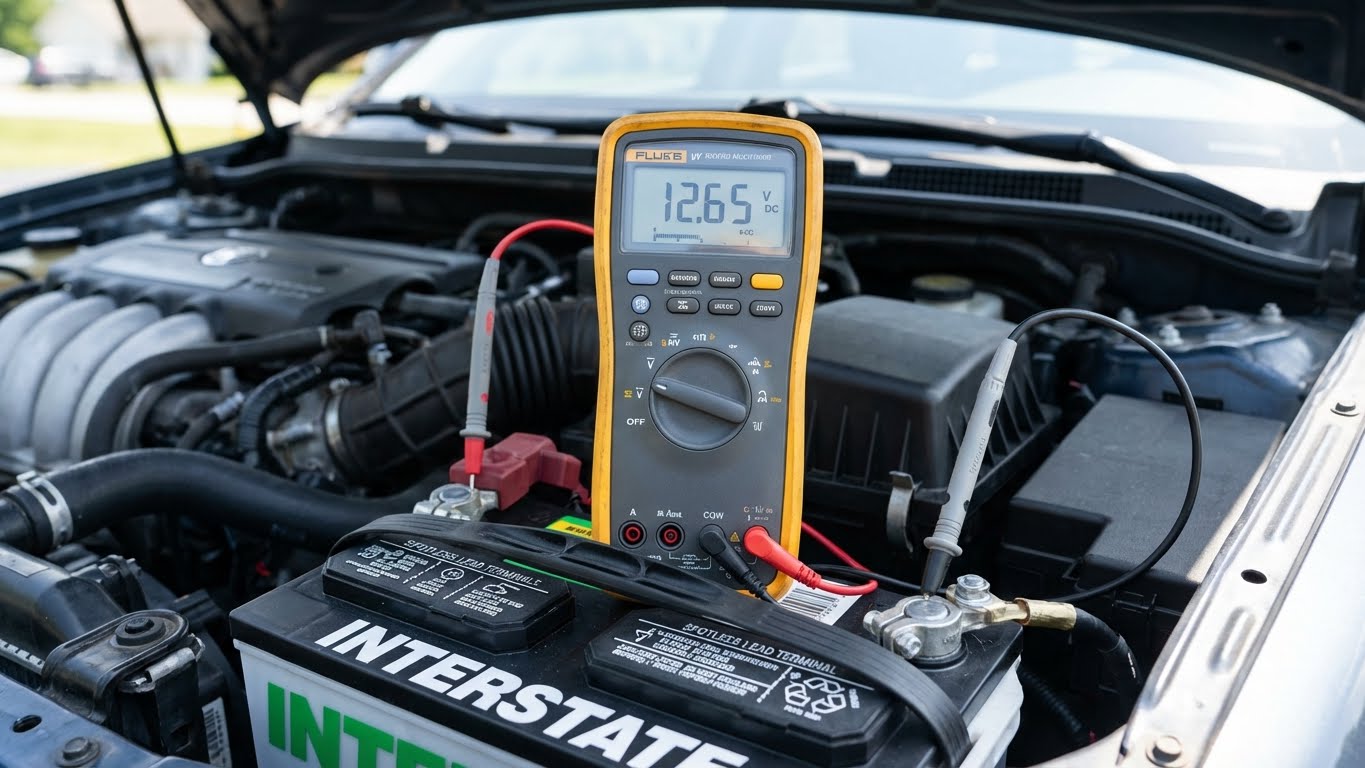
You can check a car battery’s health in minutes with a multimeter, and you don’t need special skills to get a clear answer. A healthy, fully charged battery should read about 12.6 volts or higher, so if your meter shows 12.0 volts or less, the battery is weak and likely needs charging or replacement.
Start confident and safe: turn off the car, set the meter to DC volts, and touch the red probe to the positive terminal and the black to the negative terminal. Small problems like poor connections or a surface charge can skew readings, so I’ll show simple steps to test correctly and what to do next if the voltage looks wrong.
Key Takeaways
- Use the DC volts setting and probe the battery terminals to get a quick health check.
- A reading near 12.6 V means good charge; 12.0 V or lower signals trouble.
- Check connections, charge if needed, and retest before replacing the battery.
Understanding Car Battery Basics
A car battery stores electrical energy, supplies power to start the engine, and runs accessories when the engine is off. Knowing what a battery does, how to spot failure, and why testing needs to be accurate helps you avoid being stranded.
What Is a Car Battery
A car battery is a 12-volt lead-acid unit made of six cells, each producing about 2.1 volts. Inside, lead plates and an electrolyte (sulfuric acid and water) create a chemical reaction that stores and releases energy. The battery gives a high current for a few seconds to turn the starter motor and then supports electronics like lights, radio, and engine control systems when the alternator isn’t enough.
Batteries have ratings you can read on the label: voltage (12V), cold cranking amps (CCA), and reserve capacity (minutes). CCA matters in cold weather; a higher CCA gives stronger starting power. Reserve capacity tells you how long the battery can run accessories if the alternator fails. Physical signs like corrosion or a swollen case also affect performance.
Common Signs of a Dead Battery
You’ll usually notice a dead battery when the engine cranks slowly or won’t crank at all. Dim headlights, a clicking sound when you turn the key, or electronics that behave oddly (clock resets, infotainment glitches) point to low voltage. Sometimes the car starts then dies shortly after; that can mean the alternator, but a weak battery can cause similar symptoms.
Battery age is a big clue — most lead-acid car batteries last 3–5 years under normal use. Visual checks matter: heavy corrosion on terminals, loose or damaged cables, or fluid leakage reduce performance. Cold weather and short trips accelerate wear because the battery doesn’t fully recharge.
Why Accurate Testing Matters
A reliable test tells you whether the battery itself is bad or if the charging system (alternator, cables) is at fault. That prevents unnecessary battery purchases and helps you fix the real problem. Measuring voltage under known conditions gives a clear pass/fail result you can act on.
Basic tests include a resting voltage check (engine off), a load or cranking test, and a charging voltage check with the engine running. Each test has thresholds: around 12.6V at rest means fully charged, under about 12.2V suggests a weak battery. While simple, these measurements must be done correctly — wrong settings or poor probe contact can give misleading readings.
Preparing to Test a Car Battery
You should take basic safety steps, gather a digital multimeter and gloves, and know exactly where the battery and its terminals sit. Doing these things first keeps you safe and gives accurate readings.
Safety Precautions
Wear safety glasses and chemical-resistant gloves before you touch the battery. Batteries contain acid and can spark; protect your eyes and hands from splashes and corrosion.
Turn off the engine and remove the key. Also switch off all lights, radio, and accessories so the battery is at its resting voltage when you test it.
Avoid metal jewelry and keep tools away from both terminals at once. A wrench or ring touching both terminals can short the battery and cause sparks or burns.
Work in a well-ventilated area away from open flames or smoking. Batteries can emit hydrogen gas that can ignite if it builds up.
If the battery case looks cracked, swollen, or heavily corroded, do not test it yourself. Get professional help or replace the battery to avoid injury.
Gathering Necessary Tools
You need a digital multimeter that measures DC voltage, settable to 20V or an auto-range around 0–20V. A cheap meter works fine as long as it reads to two decimal places.
Bring a clean rag, wire brush or terminal cleaner, and a small wrench for terminal nuts. Clean, tight connections give the most accurate voltage reading.
Have baking soda and water or a battery-cleaning spray handy to neutralize acid and remove corrosion. Use the rag and brush only after you disconnect or while the car is off.
Keep a flashlight or phone light ready if the battery sits in a dark area. Also have replacement gloves and eye protection available if the job takes longer than expected.
How to Locate the Car Battery
Open the hood and look near the front of the engine bay—most batteries sit on the driver or passenger side close to the firewall. Some cars place the battery near the front bumper.
Check for a plastic cover or clamp holding the battery in place. Remove the cover by unclipping or unscrewing the fastener so you can access the terminals.
If your car has the battery in the trunk or under a rear seat, consult the owner’s manual for the exact location and how to lift any trim panels safely. Many modern cars hide the battery for weight balance or space.
Identify the positive terminal with a red cover or a “+” mark and the negative terminal with a black cover or a “−” mark. Note any heavy corrosion or loose clamps before you start testing.
How to Use a Multimeter for Battery Testing
You will set the meter for DC voltage, attach the red lead to positive and black to negative, and read the displayed volts. Work with the ignition off, wear safety glasses, and keep tools away from metal that could short the terminals.
Setting Up the Multimeter
Turn the dial to the DC volts range, usually marked “V⎓” or “DCV”. If your meter has a 20V range, pick that. That range gives accurate readings for a 12V car battery.
Plug the red probe into the port labeled V or VΩ. Plug the black probe into the COM port. Check the leads for damage and clean the probe tips if they are dirty.
Make sure the car is off and any accessories (lights, radio) are off. Remove metal jewelry and wear safety glasses. If the battery is removable and you prefer, place it on a stable surface for easier access.
Connecting the Multimeter to the Battery
Identify the battery terminals: the positive terminal is marked + or has a red cover; the negative is marked – or is plain metal. Do not touch both terminals with a single tool.
Connect the red probe to the positive terminal first. Then connect the black probe to the negative terminal. Hold the probes steady or use clamps if your meter or probes include them.
If you see sparking, stop and inspect for corrosion or loose clamps. Clean corrosion with a baking soda paste and a brush, then dry the terminals before testing. Keep the probes from touching each other while connected to the battery.
Measuring Voltage
With the probes connected, read the voltage on the multimeter display. A fully charged 12V lead-acid battery should read about 12.6 to 12.7 volts at rest.
If the reading is 12.4V or lower, the battery is partially discharged and may need charging. Below about 12.0V indicates a weak battery that may struggle to start the car.
If you want to check the charging system, start the engine and read again: a healthy alternator will raise the voltage to about 13.8–14.6V. Turn on headlights or a load and watch for big voltage drops; large drops can show battery or connection issues.
Interpreting Multimeter Readings

You will learn what the voltage numbers mean for charge level and cranking ability. You will also see the clear voltage ranges that tell you when a battery is healthy, partially charged, weak, or needs replacement.
Understanding Voltage Results
A healthy, fully charged 12V car battery reads about 12.6 volts or higher at rest. If your meter shows 12.4 V, the battery is around 75% charged and will usually start the car. Readings of 12.0 V or lower indicate a weak battery that may fail to start the engine.
Measure voltage with the car off and again while cranking the engine. A drop below 10.5 V during cranking suggests the battery can’t deliver enough current. If voltage while the engine runs is 13.7–14.7 V, the alternator is charging the battery normally. Lower or higher running voltages point to charging system issues.
Identifying Good vs. Bad Battery Readings
Use these quick rules to decide what to do next:
- 12.6 V or above — Good; no immediate action needed.
- 12.4 V to 12.6 V — Partially charged; charge the battery and test again.
- 12.0 V to 12.4 V — Weak; monitor and consider replacement if problems persist.
- Below 12.0 V — Bad or discharged; charge immediately and retest; likely needs replacement if it won’t hold charge.
Also check voltage under load and while charging. If the battery won’t return to 12.6 V after a full charge, or if the voltage falls sharply during cranking, plan to replace it.
Troubleshooting Common Issues
You may see odd voltage numbers or a battery that drains while the car is off. The next parts show how to fix bad meter readings and how to find a parasitic drain step by step.
Dealing With Inaccurate Readings
If your multimeter shows a strange voltage, first check the meter settings. Set the dial to DC volts and a range above 12 V (often 20 V). A wrong setting gives wrong numbers.
Inspect the meter leads and battery. Cracked insulation, loose connectors, or a dead meter battery can cause errors. Clean the battery posts and clamp the leads to the metal post, not the plastic casing.
Measure voltage with the engine off, then with the engine running. If the resting voltage reads above 12.6 V it’s likely charged. If the running voltage is below 13.7 V or above 14.8 V, you may have charging system issues. Repeat the test a few times to confirm results.
If you still doubt the reading, test a known good battery or use a second meter. Note down numbers and conditions so you can compare later or show a mechanic.
Testing for Parasitic Drains
Start with the car off, doors closed, and all lights and accessories off. Remove the negative battery cable and set your multimeter to the highest DC amp or the dedicated mA range if available.
Place the red lead on the battery post and the black lead on the detached negative cable. Watch the current reading. Normal draw is usually under 50 mA for modern cars; a reading over 100–200 mA means excess drain.
If drain is high, pull fuses one at a time while watching the meter. When the current drops, the component on that fuse circuit is the likely culprit. Test components on that circuit (glove box light, aftermarket alarm, trunk lights) by disconnecting them or replacing fuses to isolate the fault.
Be careful: some cars draw higher current briefly for systems that go to sleep. Wait several minutes after turning everything off. If unsure, consult the vehicle manual for sleep times before concluding a parasitic drain.
Next Steps After Testing
You’ll learn what to do if the voltage reads low and when it’s time to replace the battery. Follow the specific actions below to avoid being stranded and to protect your vehicle’s electrical system.
What to Do With Low Battery Voltage
If your resting voltage is 12.4 V or lower, the battery is undercharged. First, try charging it with a smart charger for several hours, then re-test the resting voltage after at least one hour. If the battery returns to about 12.6 V, monitor it over a few days to see if it holds charge.
If charging doesn’t bring voltage up, perform a load test or have a shop do one. Check for corrosion on terminals and ensure tight connections; clean terminals with a brush and a baking soda solution if needed. Also test the alternator output (should be about 13.8–14.6 V with engine running). If the alternator is bad, the battery will continue to discharge even after charging.
Write down voltage readings and dates. If the battery repeatedly falls below 12.4 V after charging or the engine struggles to start, plan for replacement soon.
When to Replace Your Car Battery
Replace the battery if it has a cracked case, bulging sides, leaking fluid, or severe corrosion that can’t be cleaned. Also replace it if a reliable load test fails or if the battery won’t hold 12.4–12.6 V after a full charge.
Consider age: most lead-acid car batteries last 3–5 years. If your battery is older than three years and shows weak voltage or slow cranking, replace it proactively. This reduces the risk of getting stranded and protects sensitive electronics.
When you buy a new battery, match group size, cold cranking amps (CCA), and reserve capacity to your vehicle’s specs. Have the new battery installed and the charging system checked so the replacement lasts as long as possible.
Maintenance Tips to Extend Battery Life
Keep the battery clean, charged, and kept at moderate temperatures to avoid early failure. Small, regular checks and correct storage will make your battery last longer and perform better.
Regular Testing Schedule
Test your battery with a multimeter every 1–3 months, more often in hot or cold seasons. Measure resting voltage with the car off; a healthy, fully charged 12V battery reads about 12.6–12.8 V. If you see 12.4 V or lower, plan a recharge and a retest within a week.
Also test after long drives or if you use many accessories while the engine is off. Perform a load or cranking check if voltage dips below 10 V during start—this signals weak capacity. Keep a log with date, voltage, and temperature so you track trends. That helps you spot slow decline before a sudden failure.
Proper Battery Storage
Store a battery at cool, dry room temperature—ideally 50–70°F (10–21°C). High heat accelerates self-discharge and sulfation; cold slows chemical reactions and reduces starting power temporarily.
If you store a battery for more than two weeks, keep it on a maintenance charger or top it up every 30 days. Disconnect the negative cable when the battery is out of the car to prevent parasitic drain. Place the battery on a non-conductive surface and cover the terminals with caps or tape to avoid short circuits.
Environmental Considerations
You will handle toxic materials and charged cells when testing, so take steps that reduce spills, fumes, and waste. Follow local rules for disposal and recycling to avoid fines and environmental harm.
Safe Battery Disposal
Treat damaged or leaking batteries as hazardous waste. Do not throw them in regular trash. Put a leaking battery in a sturdy plastic bag or container and tape the terminals to prevent shorting. Wear gloves and eye protection when handling corrosion or acid.
Contact your local waste authority for household hazardous waste drop-off hours and rules. Many auto parts stores accept dead car batteries for safe disposal. If you transport a battery, secure it upright in the trunk or a truck bed and keep it away from heat sources and metal objects.
Battery Recycling Guidelines
Lead-acid batteries are highly recyclable; most shops and recycling centers accept them. Remove the battery from the vehicle only when the engine is cool and the key is out of the ignition. Place the battery on a non-conductive surface and avoid tilting to prevent acid spills.
When you take the battery to a recycler, bring any required ID or paperwork and ask if they pay a core charge refund. If a recycler is not available, many municipal hazardous-waste programs offer collection days. Keep records of where and when you recycled the battery in case of local compliance checks.
Conclusion
Testing a car battery with a multimeter is one of the simplest ways to understand your vehicle’s electrical health. With just a few basic safety steps, the right meter settings, and proper probe placement, you can diagnose charging issues, weak batteries, and even hidden parasitic drains in minutes. This not only saves you money but also prevents sudden breakdowns.
Remember the key voltage ranges: around 12.6 V means a fully charged battery, 12.0–12.4 V signals weakness, and anything below 12.0 V requires immediate attention. Always charge and retest before replacing, and check the alternator output to rule out charging system problems. Regular testing, clean terminals, and proper storage extend battery life and keep your car dependable in all seasons.
By following the steps in this guide, you can confidently maintain your battery, troubleshoot issues early, and ensure your vehicle starts reliably every time.